

Table of Contents
- How We Chose These Pregnancy Safe Foundations
- 1. Flawless Finish Liquid Foundation: Best Overall for Sensitive Skin
- 2. Pro Prep Face Primer: Best Base Layer for Reactive Skin
- 3. Samples of Primer & Foundation: Best Way to Patch Test Before Committing
- 4. The Refill - Foundation: Best Value for Long-Term Use
- 5. Blend it Foundation Brush: Best Application Tool for Even Coverage
- Pregnancy-Safe Makeup Ingredients: What to Look For
- Makeup Ingredients to Avoid During Pregnancy
- Frequently Asked Questions
Last Updated: October 16, 2026
How We Chose These Pregnancy Safe Foundations
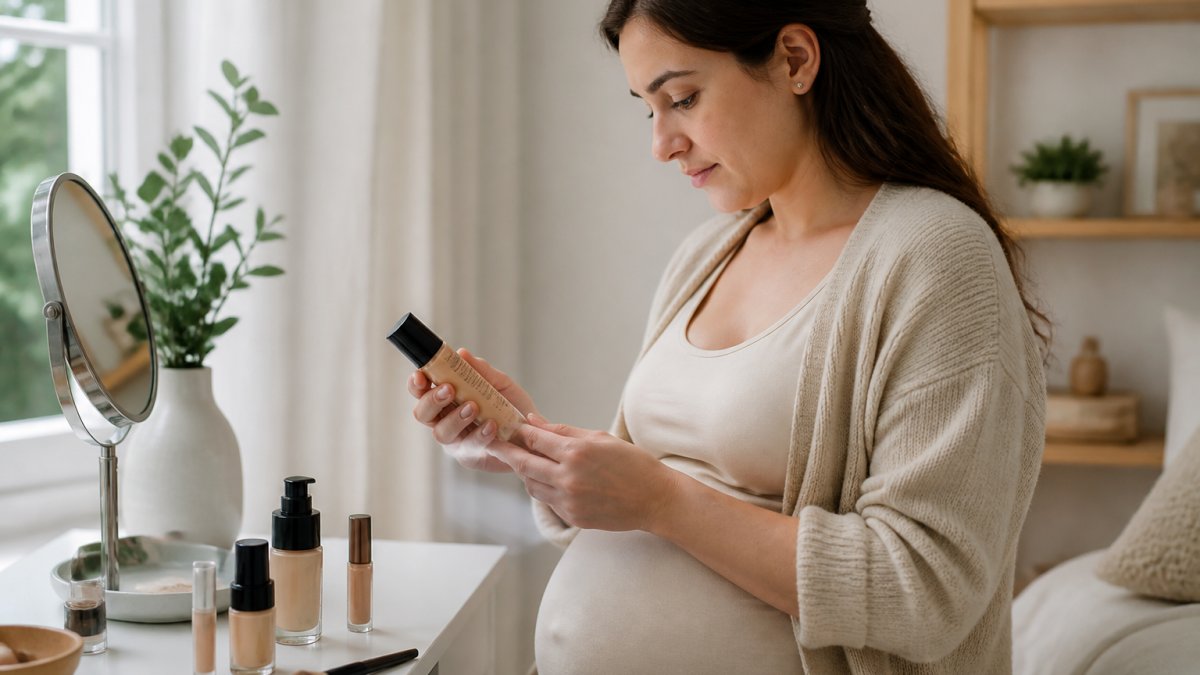
Finding a pregnancy safe foundation for sensitive skin starts with the ingredient list, not the marketing label.
Hormonal shifts can make skin more reactive, so the foundation you loved last year may suddenly sting, pill, or clog your pores.
Our Selection Criteria
We judged every product on ingredient transparency, gentleness on reactive skin, coverage and finish, and value over time. A foundation only made this list if we could show you its full ingredient list and explain what each part does.
Here is how the five picks compare at a glance:
| Product | Price | Best For | Standout Detail |
|---|---|---|---|
| Flawless Finish Liquid Foundation | $46.00 | Best overall for sensitive skin | Aloe, glycerin, zinc oxide base |
| Pro Prep Face Primer | $37.00 | Best base layer for reactive skin | Refillable glass bottle |
| Samples of Primer & Foundation | $15.00 | Patch testing before you commit | 2 shades plus primer |
| The Refill - Foundation | $37.00 | Best value long term | 1 oz refill, same formula |
| Blend it Foundation Brush | $31.00 | Even, streak-free application | Hypoallergenic, vegan |
1. Flawless Finish Liquid Foundation: Best Overall for Sensitive Skin
Our top pick leans on soothing ingredients instead of harsh ones. Flawless Finish Liquid Foundation is a breathable, buildable liquid foundation that glides over your base for a natural, dewy finish without clogging pores.

Ingredient Breakdown and Pregnancy Safety Check
Every ingredient here has a job, and none are on the common avoid list. Aloe vera heals, protects, and nourishes; glycerin helps reduce the appearance of fine lines; zinc oxide offers sun protection. Rice powder, shea butter, squalane, and chamomile hydrosol round out a base designed for reactive skin.
The formula is vegan, gluten-free, and non-GMO, made in the USA. That transparency matters more than any trendy claim.
Coverage, Finish, and Wear Time
You control the coverage: one pump gives sheer, two build to medium, three deliver full coverage. The finish stays dewy rather than matte, which suits dry or flaky pregnancy skin better.
It comes in ten shades across cool, warm, and neutral undertones, so you can match your skin instead of blending down your neck.
2. Pro Prep Face Primer: Best Base Layer for Reactive Skin
Sensitive skin often reacts to foundation because there is no barrier between the formula and bare skin.
Aloe vera and jojoba oil moisturize and improve elasticity while locking in hydration. Vitamin E, green tea leaf extract, and rosemary leaf extract protect skin against blue light and free radicals.
The bottle is refillable: buy the glass bottle once, then come back for refills. It is 80% organic and made in the USA.
3. Samples of Primer & Foundation: Best Way to Patch Test Before Committing
The smartest move for sensitive skin is to test before buying a full bottle. The Samples of Primer & Foundation set gives you three reusable glass jars: two foundation shades and a primer, with roughly four days of product in each.

That window is enough to run a proper patch test and see how your skin responds over several days, not just one afternoon.
4. The Refill - Foundation: Best Value for Long-Term Use
Once your shade is locked in, The Refill - Foundation is the economical choice: a 1 oz refill of your exact shade for $37.00, versus $46.00 for the full bottle and pump. Buy the bottle once, then refill it.
The formula is identical to the Flawless Finish Liquid Foundation: aloe vera, glycerin, and zinc oxide, with the same dewy, buildable finish.
5. Blend it Foundation Brush: Best Application Tool for Even Coverage
A good foundation can still look patchy with the wrong tool. The Blend it Foundation Brush blends, buffs, and blurs for a photo-finished look. It is 100% synthetic, vegan, cruelty-free, hypoallergenic, and virtually shed-less, so you are not leaving bristles on your face.
Flawless Finish Liquid Foundation →

Because it is hypoallergenic, it is a sensible pick for reactive skin that reacts to natural hair brushes. Pair it with the Flawless Finish Liquid Foundation for the smoothest result.
Pregnancy-Safe Makeup Ingredients: What to Look For
Pregnancy-safe makeup ingredients soothe, hydrate, and protect your skin without the compounds most often flagged for irritation or hormonal concern. This list is not a guarantee of safety, it is a starting point for reading labels with your clinician. Topical makeup exposure differs from taking a medication, and no ingredient list can promise an outcome for every pregnancy.
Here is what to look for, why it works, and where it shows up in the products above.
Soothing and barrier-support ingredients
- Aloe vera (Aloe barbadensis leaf juice), A humectant and calming agent, roughly 99% water plus polysaccharides and glycoproteins that help reduce the look of redness. It leads Flawless Finish Liquid Foundation and Pro Prep Face Primer. If you have a latex or lily-family allergy, patch test first.
- Chamomile hydrosol (Anthemis nobilis flower water), A gentle botanical distillate used for its calming properties on reactive skin, and a common swap for synthetic fragrance because it carries a soft natural scent without added perfume.
- Green tea leaf extract (Camellia sinensis), Rich in polyphenols, including EGCG, that act as antioxidants. It is one of the blue-light and free-radical defenders in Pro Prep Face Primer.
Hydration and moisture-retention ingredients
- Glycerin, A humectant that pulls water into the upper layers of skin. One of the most studied and best-tolerated cosmetic ingredients, and why Flawless Finish feels dewy rather than tight on dry pregnancy skin.
- Squalane, A lightweight, non-comedogenic emollient that mimics a lipid your skin already produces. It softens without the heaviness of heavier oils, which matters if your skin turned oilier in the second or third trimester.
- Jojoba oil (Simmondsia chinensis seed oil), Technically a liquid wax ester, not a true oil. Its structure is close to human sebum, so it is generally well tolerated and is the moisturizing backbone of Pro Prep Face Primer.
Protection and finish ingredients
- Zinc oxide, A mineral UV filter and skin protectant. It sits on top of skin rather than absorbing, which is why mineral formulas are often the first choice for reactive skin. In Flawless Finish it doubles as a mild soothing agent. It is not a substitute for a dedicated sunscreen, most foundations do not deliver enough even coverage to hit the SPF on the label.
- Rice powder (Oryza sativa), A soft-focus powder that blurs the look of pores and absorbs excess oil without the chalkiness of talc. Helpful if pregnancy hormones made your T-zone shinier.
- Vitamin E (tocopherol), An antioxidant that helps protect the formula and the skin. Rarely irritating at cosmetic levels, but high concentrations can bother very reactive skin.
How to read a label like a safety check
Work through these four questions before you buy:
- Is the full ingredient list published? If a brand hides behind "proprietary blend" or "fragrance," you cannot evaluate it.
- Where do the soothing ingredients sit? Ingredients are listed in descending order of concentration until the 1% mark. Aloe and glycerin near the top of Flawless Finish means they are doing real work.
- Is there a fragrance or essential-oil load? "Fragrance" and "parfum" can each stand in for dozens of undeclared compounds. Essential oils like citrus, peppermint, and lavender are natural but among the most common contact irritants.
- Does the formula match your current skin, not last year's? A formula that worked pre-pregnancy can sting now if your barrier is compromised.
FDA guidance on cosmetics and ingredient labeling
Makeup Ingredients to Avoid During Pregnancy
Makeup ingredients to avoid during pregnancy are the ones most often flagged for sensitive skin and hormonal concerns. This is a watchlist, not a verdict: topical cosmetics are not medications, absorption through intact skin is generally low, and the research is still evolving. Use this section to ask better questions of your clinician, not to panic-clear your vanity.
The commonly flagged categories
- Parabens (methyl-, propyl-, butyl-, ethylparaben), Preservatives detectable in urine after cosmetic use; some studies raise questions about weak estrogen-like activity. Regulators currently allow them at cosmetic concentrations, but many pregnant readers prefer to skip them. Preservative-free formulas are not automatically safer, they can grow bacteria, which is its own skin risk.
- Phthalates (often hidden under "fragrance"), Used to make fragrances last and plastics flexible. DEHP and DBP are the most discussed; DEP is most often found in cosmetics. Because they hide inside "fragrance," the only reliable way to avoid them is fragrance-free formulas.
- Synthetic fragrance and "parfum", The single most common cause of contact dermatitis in cosmetics. "Fragrance" is a trade-secret category that can contain dozens of undeclared compounds, including phthalates. If your skin is reactive, cut this first.
Sensitive-skin testing: how to actually patch test
A one-afternoon swatch tells you almost nothing. Run this protocol instead:
- Start 5-7 days before you need to wear the product. Skin reactions can be delayed.
- Cleanse and dry a small area, the inner forearm first, then the jawline if the forearm is clear.
- Apply a thin layer of the foundation and, separately, the primer. Test one at a time so you know which caused a reaction.
- Leave it on for 24 hours, then reapply daily for 3-4 days. Watch for redness, itching, burning, small bumps, or flaking.
- If you react, stop and photograph the area. Bring the photo and the ingredient list to your dermatologist or OB.
- Only then apply to the full face, on a day you have nowhere to be.
This is exactly why the Samples of Primer & Foundation set exists: two shades plus a primer, roughly four days of product in each jar, enough to run the full protocol before committing to a $46.00 bottle.
Pregnancy skin changes and what they mean for wear
Your skin may not behave the way it did six months ago. Match the formula to the change, not your old routine:
- Dryness and flaking, Humectants and emollients (glycerin, squalane, jojoba) help. Avoid matte, high-alcohol formulas that emphasize flakes. A dewy finish like Flawless Finish wears better here.
- Oiliness and shine, Hormonal shifts can ramp up sebum. Rice powder and lightweight primers help; heavy occlusive bases slide by midday.
- Redness and reactivity, Aloe, chamomile, and green tea are the calming trio to look for. Skip fragrance and essential oils entirely.
ACOG guidance on skin changes during pregnancy
Frequently Asked Questions
How can I check whether a foundation is pregnancy-safe?
Start by reading the full ingredient list and looking for known irritants like parabens, phthalates, and synthetic fragrances. Check whether the brand publishes third-party testing or certifications. Look for gentle formulas with recognizable botanicals like aloe vera, glycerin, and zinc oxide. If you are unsure about a specific ingredient, bring the list to your OB-GYN or dermatologist before applying it daily. A patch test on your inner arm for 48 hours can also flag reactions before you commit to full-face wear.
Which foundation ingredients should I avoid during pregnancy?
Common makeup ingredients to avoid during pregnancy include parabens, phthalates, formaldehyde releasers, and synthetic fragrance. Retinoids and high-dose salicylates are also worth skipping in leave-on products. When in doubt, ask your doctor about specific ingredients you use daily.
Can pregnancy make sensitive skin more reactive to makeup?
Hormonal shifts during pregnancy can increase skin sensitivity, redness, and reactivity to products that previously caused no issues. Some women develop contact dermatitis or breakouts from foundations they wore for years. Switching to a pregnancy-safe foundation with a shorter, gentler ingredient list and doing a patch test before full application can reduce irritation risk. If a product burns or causes a rash, stop using it and check with your dermatologist.
Are skin tints safe to use during pregnancy?
A pregnancy-safe skin tint can be a good option if you want lighter coverage with fewer ingredients. The key is the ingredient list, not the product category. Always patch test first and confirm with your healthcare provider if you have specific concerns.
Should I ask my doctor before using foundation while pregnant?
Yes, it is wise to check with your OB-GYN or dermatologist, especially if you have a history of skin reactions or are using active ingredients. Most topical cosmetics sit on the skin's surface and absorb minimally, but individual risk factors vary. Bring the ingredient list to your appointment so your doctor can review it. If your doctor clears the product and you patch test without reaction, you can feel confident wearing it as part of your pregnancy routine.
Your skin is doing something remarkable right now, and it deserves makeup that works with it rather than against it. Clean Beauty by Joy makes that easier with formulas built on aloe vera, glycerin, and zinc oxide, a refillable system that saves money over time, and a sample set that lets you patch test before committing. Get started with Clean Beauty by Joy and find the shade that keeps your skin calm, hydrated, and glowing through every stage.

