

Last Updated: November 1, 2026
Quick Summary
Organic skincare for nursing mothers offers gentle hydration and barrier support rather than a magic category, since organic, natural, and safe are three different claims. Research on cosmetic use during pregnancy and lactation has not found that everyday products raise the risk of harm to a developing baby, according to a review in Canadian Family Physician. Focus on simple, fragrance-light formulas and keep strong actives away from the chest and nipple area.
- Apply products with the strongest actives to areas your baby touches least, like face and backs of hands.
- Wash hands after applying body products to reduce hand-to-mouth transfer when you pick up the baby.
- Postpartum skin is drier and more reactive, so lean on hydration and barrier support over exfoliation.
- Introduce one new product at a time and give it two weeks before adding another.
- Choose a body lotion with short ingredient lists and jojoba, shea, or oat over long fragrance blends.
Table of Contents
- Why Organic Skincare for Nursing Mothers Deserves a Closer Look
- Organic, Natural, and Safe: What the Labels Actually Mean
- Safe Skincare Ingredients While Breastfeeding
- What Skincare to Avoid While Breastfeeding
- Building a Breastfeeding-Safe Skincare Routine
- Finding a Body Lotion Safe While Breastfeeding
- Choosing Your First Organic Skincare Products
- Frequently Asked Questions
Why Organic Skincare for Nursing Mothers Deserves a Closer Look
Nursing mothers get handed a lot of advice about what to put on their skin, and most of it is louder than it is useful. The honest starting point is this: research on cosmetic use during pregnancy and lactation has not found that everyday skin-care products raise the risk of malformations or other harm to a developing baby, according to a review published in Canadian Family Physician.
At Clean Beauty by Joy, we have learned that nursing moms want two things at once: products that feel clean and gentle, and a straight answer about what "clean" even means. This guide gives you both. Below, we walk through what the labels mean, which ingredients deserve caution, how to build a simple routine, and how to spot a body lotion safe while breastfeeding.
Organic skincare for nursing mothers is not a magic category. It is a set of choices about ingredients, formulation, and how much you actually know about what is in the bottle.
Organic, Natural, and Safe: What the Labels Actually Mean
Here is the part most guides get wrong: organic, natural, and safe are three different claims, and only one of them is about risk.
- Organic describes how ingredients were grown and processed. It says nothing about whether a finished product suits your skin.
- Natural means ingredients came from plants, minerals, or other living sources. Poison ivy is natural.
- Safe is about the specific ingredients, the concentration, and how your skin responds.
A product can be organic and still sting. A product can be synthetic and still be gentle.
If the word "nontoxic" on a bottle leaves you more confused than before, our breakdown of whether nontoxic makeup for pregnancy is worth it looks at what those claims actually deliver.
Safe Skincare Ingredients While Breastfeeding
The gentlest place to start is with ingredients that mainly do one job: hold water in the skin and keep the barrier calm.
- Plant oils such as jojoba, rosehip seed, and black seed oil, which soften and seal in moisture
- Glycerin and hyaluronic acid, which pull water into the skin
- Shea and cocoa butter, which cushion dry, stretched skin
A common mistake is stacking five "clean" actives at once and then blaming the brand when skin flares.
If you are also checking the rest of your routine for parabens and phthalates, our guide to nontoxic makeup without parabens and phthalates walks through ingredient lists line by line.
What Skincare to Avoid While Breastfeeding
No federal rulebook bans specific cosmetics for nursing parents. The FDA regulates cosmetics for safety and labeling but does not certify products as "breastfeeding-safe," and no agency publishes a nursing-specific banned-ingredient list. That means the work of sorting ingredients falls to you, and the useful way to do it is by tiering ingredients by how strong the evidence of concern actually is, rather than lumping every synthetic into one bucket and every plant into another.
Ingredients with established concerns
- Retinoids (retinol, tretinoin, retinyl palmitate). Dermatologists routinely advise pausing topical retinoids during pregnancy, and most parents continue to avoid them while nursing as a precaution. The concern is dose and absorption, and the precautionary approach is well established even where lactation-specific data are thin.
- High-concentration salicylic acid peels. Low-strength salicylic acid in a face wash is generally treated as low-risk, but professional-strength peels deliver far more active ingredient across a larger skin area. Save the peel for after weaning.
- Hydroquinone. Used for melasma, which is common postpartum. Many practitioners recommend pausing it during nursing and using azelaic acid or vitamin C instead; ask your clinician which option fits your situation.
Ingredients with limited or mixed evidence
- Phthalates and parabens. Public concern is real, but the evidence for harm at cosmetic exposure levels is not settled. If avoiding them helps you feel confident, that is a reasonable choice, just know it is a preference backed by precaution, not a proven hazard at typical use.
- Chemical (organic) UV filters such as oxybenzone. Absorption into the bloodstream is documented; whether that absorption matters at cosmetic levels is still debated. Mineral filters (zinc oxide, titanium dioxide) are the lower-uncertainty choice, especially on the chest and hands.
- Botanical extracts marketed as "hormone-balancing." Claims like these are marketing, not regulation. No cosmetic is approved to balance hormones, and a plant extract can still irritate reactive postpartum skin.
The exposure pathway most guides skip
There are three ways a skincare product can reach your baby during nursing, and they are not equally important:
- Topical absorption into your bloodstream, then into milk. This is the pathway people worry about most and the one with the least evidence of meaningful transfer from typical cosmetic use. The skin barrier is a real barrier.
- Hand-to-mouth transfer. You apply lotion, then pick up the baby, adjust a strap, or offer a finger to suck. This pathway is easy to overlook and easy to manage: wash hands after applying anything to your body, and apply body products after a feed rather than before.
- Direct contact with the breast and nipple. This is the pathway that deserves the most attention, because the skin your baby contacts most is the skin you are most likely to treat. Anything left on the nipple can be tasted, and occlusive balms can trap moisture and contribute to irritation.
A practical rule of thumb
Apply the products with the strongest actives to the parts of your body your baby touches least, face, neck, backs of hands after washing, and keep the chest and nipple area to short, simple, fragrance-light formulas. That single habit does more than swapping every bottle in your cabinet.
If you are also auditing the rest of your routine for parabens and phthalates, our guide to nontoxic makeup without parabens and phthalates walks through ingredient lists line by line, and our guide to safe makeup ingredients for pregnancy covers what to keep off the skin while you are nursing.
Building a Breastfeeding-Safe Skincare Routine
A breastfeeding-safe skincare routine is short, gentle, and repeatable, and it has to survive a day that includes feeds every two to three hours, interrupted sleep, and about four minutes of bathroom time to yourself. Most routine guides are written for someone with a free twenty minutes. This one is written for the parent who has four.
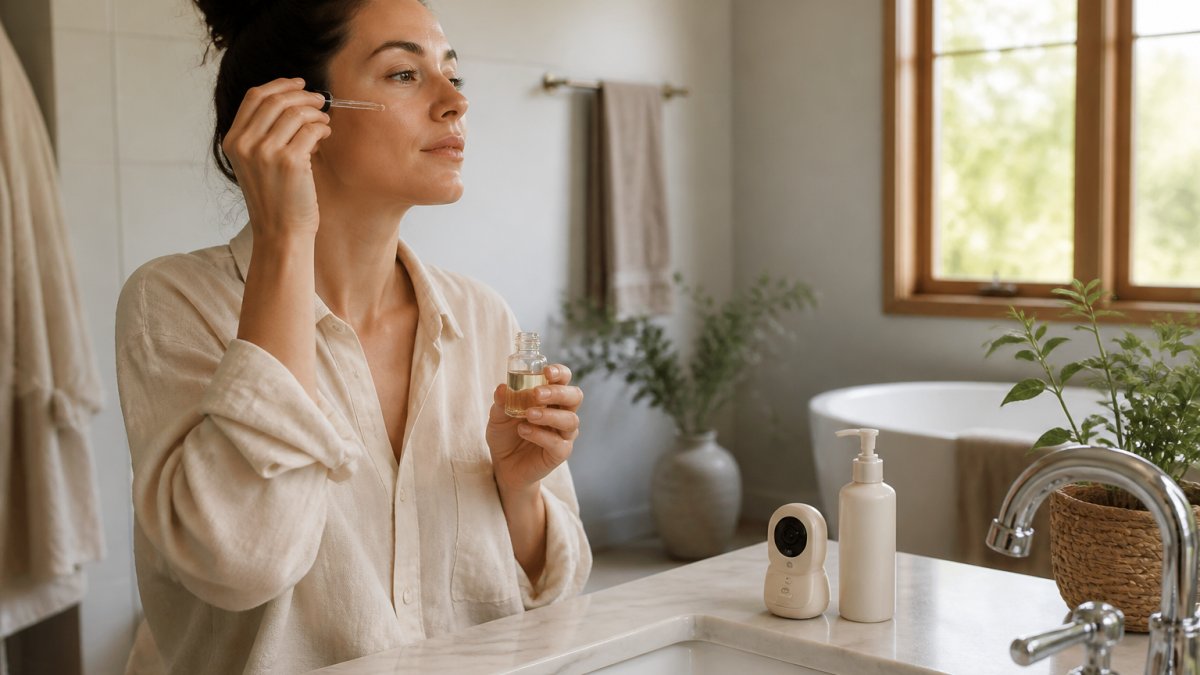
Why postpartum skin behaves differently
Two things change after delivery. First, estrogen and progesterone drop sharply, which reduces oil production and can leave skin drier and more reactive than it was in pregnancy. Second, sleep disruption and the physical demands of feeding raise cortisol and slow barrier recovery, so irritation that used to fade overnight can linger for days.
That is why the routine below leans on hydration and barrier ingredients rather than exfoliation or brightening. It is not that those ingredients are off-limits, it is that a reactive barrier does not need more stimulation.
The four-minute morning
- Rinse or cleanse (30 seconds). Lukewarm water and a mild, fragrance-light cleanser. If your skin feels tight after washing, the cleanser is too strong, switch to a cream or oil cleanser rather than adding a moisturizer to compensate.
- Hydrate on damp skin (60 seconds). Apply a plant-oil serum or simple moisturizer while skin is still damp. Damp skin absorbs humectants (glycerin, hyaluronic acid) better than dry skin, and the oil or butter on top seals them in. This is the step that does the most work.
- Protect (60 seconds). Mineral sunscreen on face, neck, and the backs of your hands, the hands get sun exposure every time you are outside with a stroller. Zinc oxide and titanium dioxide sit on top of the skin and are the lower-uncertainty choice while nursing.
- Hands (30 seconds). Wash your hands after the sunscreen step. It is the simplest way to reduce hand-to-mouth transfer when you pick up the baby.
The two-minute evening
- Cleanse the same way as the morning. If you wore sunscreen, a single gentle cleanse is enough for mineral formulas; no double-cleansing required.
- Treat the barrier, not the breakout. If you are dealing with postpartum acne, resist the urge to add a strong acid. A gentle salicylic acid cleanser a few times a week is a reasonable middle ground for many parents; a leave-on retinoid is the one most practitioners suggest saving for after weaning.
- Seal with a moisturizer or facial oil on damp skin, and apply body lotion to the chest and stomach while skin is still damp from the shower.
What to skip while you are this tired
- Multi-step routines. Every additional product is another chance for irritation and another thing to patch test.
- New actives introduced all at once. Introduce one product at a time and give it two weeks before adding another, so you can tell what is working.
- Anything that stings. If a product burns, it is not "working." Postpartum skin is more reactive, and stinging is a signal to stop, not to push through.
Making it stick
Keep the products you use every day within arm's reach of the sink, and keep the ones you use weekly out of sight. The routine that survives the newborn stage is the one that requires the fewest decisions.
For the hydrating step, our Organic Radiance Serum is a cold-pressed blend of jojoba, rosehip seed, black seed, neem, and castor oils, made without parabens, synthetics, or fragrance, a single oil that covers the hydrate-and-seal step in one bottle, which is exactly what a four-minute routine needs.

Finding a Body Lotion Safe While Breastfeeding
A body lotion safe while breastfeeding is one you would be comfortable using on skin your baby touches.
We would choose a lotion with jojoba, shea, or oat over one with a long fragrance blend.
For your face, our Organic Radiance Serum is a cold-pressed blend of jojoba, rosehip seed, black seed, neem, and castor oils, made without parabens, synthetics, or fragrance.
Choosing Your First Organic Skincare Products
Start with one product, not five. A serum or a moisturizer is the easiest first step because it stays on the skin and does the most hydrating work.
- Check the full ingredient list, not the front label
- Patch test on your inner arm for a few days
- Buy small so you can switch if your skin disagrees
Our Organic Radiance Serum is a simple place to begin if you want a single organic facial oil that does the hydrating and calming work in one step.
Frequently Asked Questions
Is organic skincare safer to use while nursing?
Organic labeling alone does not prove a product is safer. A 2011 review in Canadian Family Physician found skin-care products are not expected to raise the risk of malformations or other adverse effects on a developing fetus, and one source notes cosmetics are generally considered safe while breastfeeding. What matters more is the ingredient list: fragrance, harsh exfoliants, and drying alcohols are worth skipping. Check labels and ask your doctor about anything you are unsure of.
What skincare ingredients should you avoid while breastfeeding?
Two common ones to leave out are retinoids and high-concentration salicylic acid peels. Skip synthetic fragrance and drying alcohols if your skin is reactive. MotherSafe guidance recommends checking ingredients and avoiding certain products rather than assuming natural means safe. Patch-test anything new on your inner arm first, and keep the routine simple so you can spot a reaction quickly.
Can skincare products affect breast milk?
The research supplied does not establish that everyday skincare products affect breast milk. A 2016 study of personal-care product use during pregnancy and postpartum found use varied by income and country of birth, with general hygiene products used most often, but it did not measure milk transfer. Ask your doctor or a lactation consultant about specific ingredients if you are concerned, and avoid applying strong products directly to the breast and nipple area.
What body lotion is safe to use while breastfeeding?
Look for a lotion with a short ingredient list: plant oils, shea or cocoa butter, glycerin, and no synthetic fragrance. Apply it after a shower while skin is damp to lock in moisture. Avoid putting lotion on the nipple area before a feed, since baby's mouth contacts that skin directly. If you want a facial option too, the Organic Radiance Serum at $65 uses jojoba, rosehip, and black seed oils and is free from parabens and fragrance.
Nursing already asks a lot of you. Your skincare should not add another decision to the pile. Clean Beauty by Joy makes nontoxic, botanical-based products for pregnant, nursing, and postpartum skin, formulated with organic ingredients and free from parabens, synthetics, and fragrance. Shop the Organic Radiance Serum and give your skin one simple, gentle step it can count on.


