

Last Updated: November 2, 2026
Quick Summary
Blue light protection means layering antioxidants such as Vitamin C, Vitamin E, green tea, and rosemary extracts to neutralize the oxidative stress blue light and air pollutants create, while sunscreen defends against the sun's blue-light wavelengths. Cleanse gently at night, apply serum to damp skin, moisturize, then add primer as a protective base.
- Air pollutants clog pores, trigger inflammation, and wear down your skin barrier over time.
- Apply your antioxidant layer in the morning and reapply sunscreen at midday for blue-light defense.
- Anti-pollution claims in personal-care launches grew at a 4% compound annual growth rate from 2020 to 2024.
- Layer products thin to thick, water-based before oil-based, with antioxidants before moisturizer.
- The Pro Prep Face Primer refill costs $29.00 versus $37.00 for the full bottle.
Table of Contents
- Environmental Stressors and What They Do to Your Skin
- What Anti-Pollution Skincare Actually Means
- How Blue Light Protection for Skin Works
- Antioxidants for Skin Protection: Vitamin C, Vitamin E, and Niacinamide
- Does Makeup Protect Skin From Pollution?
- How to Layer Products in a Sustainable Daily Routine
- How to Evaluate Anti-Pollution Claims Before You Buy
- Build Your Environmental Defense Routine With Clean Beauty by Joy
- Frequently Asked Questions
Environmental Stressors and What They Do to Your Skin
Your skin faces a daily assault that never shows up on a weather report. According to the National Institute of Environmental Health Sciences, air-pollution exposure is linked to oxidative stress and inflammation in human cells.
At Clean Beauty by Joy, we hear the same worry from customers: "Is my skin actually under attack, or is this just marketing?" It is not marketing.
Here is the short version before we go deeper:
- Air pollutants attach to your skin and trigger irritation
- Blue light from screens adds another layer of stress
- Free radicals damage collagen and speed up visible aging
Below, we break down each stressor and show you exactly how to build a routine that defends your skin without harsh ingredients.
Air Pollutants and Urban Exposure
Air pollutants are tiny particles and gases that settle on your skin throughout the day. They come from traffic, smoke, dust, and industrial sources.
These particles do not just sit there. They clog pores, trigger inflammation, and wear down your natural barrier over time.
The fix is not complicated. Cleanse gently at night to remove pollution particles and impurities. Then follow with antioxidants that neutralize free radicals before they cause damage.
Oxidative Stress and Free-Radical Damage
Oxidative stress happens when free radicals outnumber your skin's ability to neutralize them.
The result shows up as fine lines, dullness, and uneven tone. It also feeds inflammation, which is why sensitive and reactive skin flares up more in polluted environments.
Antioxidants for skin protection are your main defense here. They donate electrons to free radicals and stop the chain reaction before it spreads.
What Anti-Pollution Skincare Actually Means
Anti-pollution skincare is a category of products designed to block, remove, or neutralize environmental stressors before they damage your skin. It is not one ingredient or one step. It is a layered approach.
That approach usually includes:
- Cleansing to remove pollution particles and impurities
- Antioxidants to neutralize free radicals
- Moisturizers to support barrier function and skin hydration
Most guides treat anti-pollution skincare as a single product you buy. That framing is wrong. Real protection comes from the order you apply things and the consistency you keep.
How Blue Light Protection for Skin Works
Blue light protection for skin is the practice of using ingredients and products that defend against blue-violet light from screens. It works mainly by adding antioxidants that neutralize the oxidative stress blue light can create, rather than by blocking the light itself.
Most guides either overstate blue-light danger or wave it away. Here is the honest middle ground.
What the evidence actually shows
Blue light sits in the 380 to 500 nanometer range of the visible spectrum. The sun is by far your largest source. Screen exposure is real but much lower in intensity, and the research on screen-level blue light and skin aging is still developing. A fair reading is that blue light is one more oxidative stressor in a day already full of them, not a singular threat.
How screen exposure compares with sunlight
- Sunlight delivers blue light at intensities that can drive pigmentation and oxidative stress, especially during peak midday hours.
- Screens deliver a small fraction of that intensity, but the exposure is cumulative across a long workday.
- The practical takeaway: do not skip sunscreen to worry about your laptop. Treat blue light as a secondary stressor that antioxidant skincare addresses alongside UV and pollution.
What actually helps
- Antioxidants such as Vitamin C, Vitamin E, green tea, and rosemary extracts help neutralize the oxidative stress blue light can create.
- Sunscreen remains the single most effective defense against the blue-light wavelengths that matter most, because it addresses the sun source directly.
- Consistency matters more than any single product. A daily antioxidant layer does more than an occasional blue-light-specific purchase.
Innova Market Insights data reported by Personal Care Insights shows anti-pollution claims in personal-care launches grew at a 4% compound annual growth rate from 2020 to 2024. Consumers are paying attention. So are formulators.
Our Pro Prep Face Primer was built for this. For a serum-based antioxidant layer, our Organic Radiance Serum pairs natural sources of vitamins A, C, and E with essential fatty acids to defend against environmental damage while it hydrates.

Antioxidants for Skin Protection: Vitamin C, Vitamin E, and Niacinamide
Antioxidants for skin protection work best as a team, not a solo act. Each one handles a slightly different job.
- Vitamin C brightens tone and supports collagen
- Vitamin E defends against oxidative stress and pairs well with Vitamin C
- Niacinamide supports the skin barrier and calms redness
You do not need ten products. You need a few well-chosen ones applied in the right order.
Our Organic Radiance Serum is built around this idea. It packs natural sources of vitamins A, C, and E plus essential fatty acids, and it helps defend against environmental damage while it hydrates.
Does Makeup Protect Skin From Pollution?
Makeup can protect skin from pollution when it contains barrier-supporting and antioxidant ingredients.
Think of it as a shield, not a cure.
Our Pro Prep Face Primer uses aloe vera and jojoba oil to nourish skin while it locks in hydration.

If you have reactive skin, a lightweight base matters. Our guide to the best lightweight foundation for reactive skin covers what to look for.
How to Layer Products in a Sustainable Daily Routine
Layering is where most routines fall apart. People buy good products and apply them in the wrong order, so nothing works the way it should.
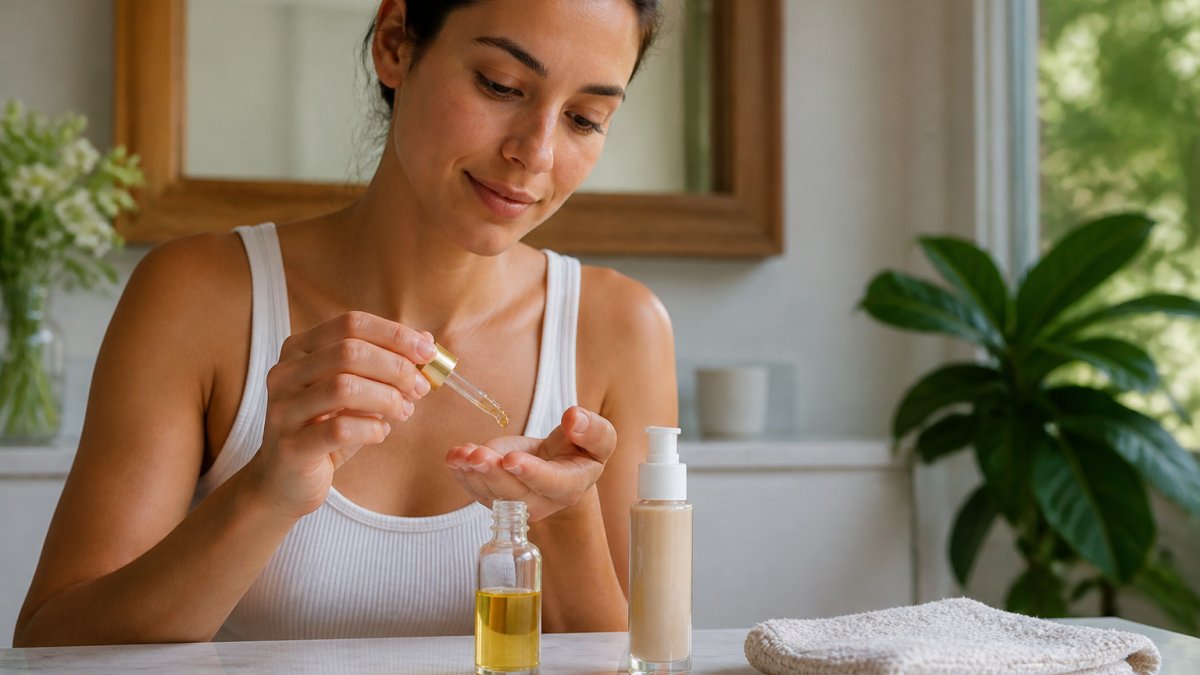
The order that works for most skin
- Cleanse gently to remove impurities. Use lukewarm water and avoid over-cleansing, which strips the barrier.
- Apply serum to damp skin, 4 to 5 drops. Antioxidants go first so they contact skin directly.
- Moisturize to seal in hydration and support barrier function.
- Add primer as your protective base if you wear makeup.
- Apply makeup if you wear it.
- Cleanse again at night to remove the day, then repeat the serum and moisturizer steps.
Adjust for your skin type
- Oily or acne-prone: use a lightweight gel moisturizer and skip heavy oils. A water-based serum layers cleanly under primer.
- Dry or mature: layer a hydrating serum, then a richer moisturizer, then primer. Give each step a minute to absorb.
- Sensitive or reactive: introduce one new product at a time and patch-test first. Fewer steps often work better than more.
Ingredient compatibility to watch
- Vitamin C and Vitamin E pair well and reinforce each other.
- Niacinamide layers comfortably with most antioxidants.
- Strong exfoliating acids can irritate skin already stressed by pollution, so alternate rather than stack them.
Make the routine lower-waste
Sustainability fits here too. A few practical choices cut waste without overstating environmental benefits:
- Choose refillable packaging where you can. Our primer comes in a refillable glass bottle, and the refill costs $29.00 versus $37.00 for the full bottle. You keep the pump and buy refills.
- Buy fewer, multi-tasking products instead of a ten-step shelf of half-used bottles.
- Use what you have first before adding a new step.
Want to go deeper on barrier care? Read our guide on how to protect your skin microbiome.
The article lays out a simple order to follow each morning and night.
Step |
What to do |
Note |
|---|---|---|
1 |
Cleanse gently with lukewarm water |
Avoid over-cleansing, which strips the barrier |
2 |
Apply serum to damp skin, 4 to 5 drops |
Antioxidants go first, on bare skin |
3 |
Moisturize |
Seals in hydration and supports barrier function |
4 |
Add primer |
Protective base if you wear makeup |
5 |
Apply makeup |
Optional step |
6 |
Cleanse again at night, repeat serum and moisturizer |
Removes the day |
How to Evaluate Anti-Pollution Claims Before You Buy
Claims are easy to print. Proof is harder. Use this checklist before you spend money.
- Does the label name specific ingredients, not vague "botanical blends"?
- Are antioxidants like Vitamin C, Vitamin E, or niacinamide listed?
- Is the brand transparent about what it does and does not test?
A 2025 review in ScienceDirect on cosmetic ingredient safety notes that exposure to cosmetic ingredients raises health and environmental concerns, and that careful ingredient safety assessment matters. "Clean" is a claim, not a guarantee.
If you are comparing clean brands, our guide to non-toxic makeup brands breaks down what to trust.
Build Your Environmental Defense Routine With Clean Beauty by Joy
Protecting against environmental stressors like blue light and air pollutants for sustainable beauty comes down to three habits: cleanse, defend with antioxidants, and support your barrier. Do those consistently and your skin has a real chance to recover.
We built Clean Beauty by Joy for exactly this. Our formulas use organic, nontoxic botanicals that support a healthy skin microbiome. They fight inflamm-aging and oxidative stressors, and they are safe for pregnant, nursing, postpartum, and menopausal skin.
Here is where to start:
- Organic Radiance Serum for antioxidant defense and hydration
- Pro Prep Face Primer for blue light and free-radical protection
- Refillable packaging to cut waste
For an inside-out approach, doTERRA's Ikise Skincare line is another option worth exploring, and their Yarrow Pom Oil Capsules are formulated to support better hair, skin, and nails from within.
Frequently Asked Questions
Can blue light from screens actually affect your skin?
Blue-violet light from laptops, phones, and televisions sits close to UV rays on the spectrum, and researchers link it to free-radical activity that can contribute to premature aging and uneven tone. The National Institute of Environmental Health Sciences notes that environmental exposures drive oxidative stress and inflammation in human cells. You do not need to avoid screens, but wearing a primer or serum with vitamin E, green tea leaf extract, or rosemary leaf extract adds a layer of blue light protection during long screen days.
How can I protect my skin from air pollution?
Start with cleansing to remove pollution particles that settle on skin, follow with antioxidants that neutralize free radicals, and finish with a moisturizer that supports barrier function. A primer or foundation with protective ingredients adds another layer during the day. Look for vitamin C, vitamin E, niacinamide, and botanical extracts on the label, and reapply sunscreen, since UV exposure compounds the damage airborne pollutants cause.
Does makeup protect skin from pollution?
It can, if the formula is built for it. A primer with vitamin E, green tea leaf extract, and rosemary leaf extract creates a barrier that shields skin from free radicals and blue light while it smooths the surface for foundation. Clean Beauty by Joy's Pro Prep Face Primer is 80% organic and designed for exactly this, so your base layer does double duty: it preps your complexion and defends against environmental stressors.
What ingredients help protect skin from environmental stressors?
Antioxidants are the core: vitamin C, vitamin E, niacinamide, CoQ10, and botanical extracts like green tea and rosemary. Hydrators such as jojoba oil and aloe vera support the skin barrier so it holds moisture against pollution and dry indoor air. Clean Beauty by Joy's Organic Radiance Serum combines jojoba, rosehip seed, and black seed oils with frankincense and blue tansy, delivering natural vitamins A, C, and E that help defend against environmental damage.
Your skin faces pollution and screen time every single day, and it cannot opt out. You can give it backup. Get started with Clean Beauty by Joy and build a routine that defends your skin while it restores your glow.


