

Last Updated: November 5, 2026
Quick Summary
To treat hormonal acne while breastfeeding, use a simple three-step routine: a gentle non-comedogenic cleanser, one breastfeeding-safe active such as azelaic acid or benzoyl peroxide, and a barrier-supporting moisturizer. Apply actives after a feed, wash your hands, and keep strong actives away from the breast area.
- Postpartum estrogen and progesterone drop while androgens stay steady, ramping up oil production.
- Judge progress in weeks, not days; a gentle routine needs four to six weeks to assess.
- Start with one active every other night, then move to nightly if tolerated.
- Keep benzoyl peroxide and salicylic acid off the breasts and chest.
- See a provider if nodules are painful, scarring occurs, or OTC options fail after two to three months.
Table of Contents
- Why Breastfeeding Triggers Hormonal Acne
- How Long Does Postpartum Acne Last?
- The Best Acne Treatment While Breastfeeding: A Step-by-Step Routine
- How to Treat Hormonal Acne While Breastfeeding Natural and Ingredient-Safe
- Breast and Chest Application Precautions for Nursing Moms
- When Acne Is Severe, Painful, or Scarring: Next Steps
- Build Your Breastfeeding-Safe Skincare Routine With Clean Beauty by Joy
- Frequently Asked Questions
Why Breastfeeding Triggers Hormonal Acne
If you're wondering how to treat hormonal acne while breastfeeding, start with this: the breakouts are not a sign that something is wrong with your routine. They're a sign your hormones are doing exactly what postpartum hormones do.
Here's the short answer: after delivery, estrogen and progesterone drop sharply while androgens stay relatively steady. That shift ramps up oil production, and more sebum means more clogged pores.
Hormone Fluctuations, Sebum, and Clogged Pores
Hormonal acne is acne driven by androgen-related oil production, typically showing up along the jawline, chin, and lower face.
The result is a cycle you can probably recognize:
- Sebum output increases
- Dead skin cells trap inside the pore
- Comedones form (blackheads and whiteheads)
This is ordinary acne vulgaris with a hormonal trigger. It is not a skin failure.
How to Tell Hormonal Acne From Other Postpartum Skin Conditions
Not every postpartum bump is acne. A common mistake is treating a rash with acne products for weeks while it gets worse.
Here's how to tell them apart:
- Hormonal acne: deep, tender bumps on the jawline and chin, plus blackheads and whiteheads. Flares around your cycle if it has returned.
- Contact dermatitis: itchy, dry, flaky patches that appear where a product touches your skin.
- Folliculitis: small uniform bumps around hair follicles, often on the chest or back.
If a rash itches or burns rather than feeling like a clogged pore, stop the acne treatment and check with your healthcare provider.
How Long Does Postpartum Acne Last?
Postpartum acne often settles as hormone levels stabilize, though some people notice breakouts continue until weaning or until their cycle returns.
There's no single timeline. It depends on your hormones, genetics, and how consistently you care for your skin barrier.
What we tell readers is this: judge progress in weeks, not days. A gentle routine needs four to six weeks before you can fairly assess it.
The Best Acne Treatment While Breastfeeding: A Step-by-Step Routine
The best acne treatment while breastfeeding is a simple three-step routine: a gentle cleanser, one breastfeeding-safe active, and a barrier-supporting moisturizer. Keep it short. Fewer products mean fewer chances of irritation and less guesswork about what's helping.
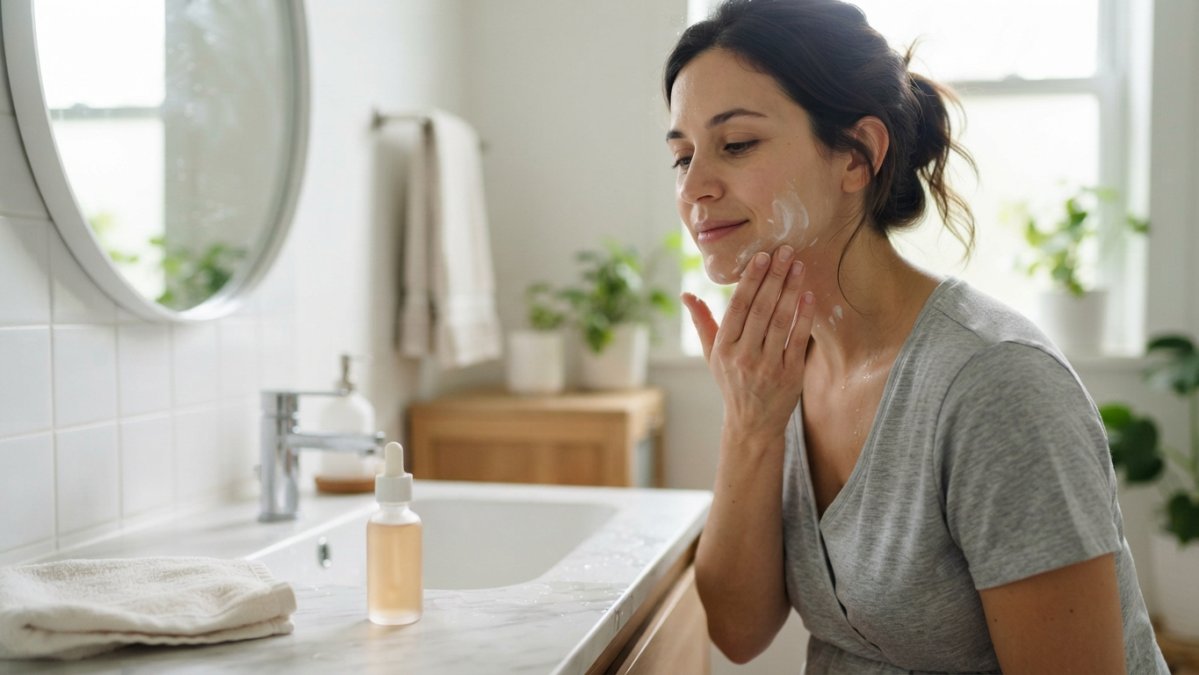
The order you introduce products matters, and so does how you keep them away from your baby. Here is a routine that walks through both.
Step 1: Cleanse Gently, Twice a Day
Wash morning and night with a mild, non-comedogenic cleanser. Use lukewarm water and your fingertips. Skip scrubs, cleansing brushes, and anything that leaves your skin tight.
Over-washing is a common mistake. Stripping the skin barrier triggers more inflammation, and inflammation makes breakouts look angrier. Two gentle cleanses beat five harsh ones.
Watch out: if your skin stings when you apply moisturizer, your cleanser is likely too harsh, switch to a cream or lotion cleanser before adding any active.
Step 2: Treat With a Breastfeeding-Safe Active
This is where clear guidance matters most. A narrative review in the Journal of the American Academy of Dermatology notes that topical therapies such as benzoyl peroxide, azelaic acid, and keratolytics can be used for mild-to-moderate acne during pregnancy and lactation.
In practice, that means:
- Azelaic acid: a strong first choice. It calms inflammation and helps with redness. A thin layer on the jawline and chin is usually enough.
- Benzoyl peroxide: effective, but apply it only to the breakout area. Keep it away from the chest and never apply it right before nursing.
- Salicylic acid: widely used in low-strength washes. Ask your provider before leaving it on the skin all day.
Start with one active, not three. Apply a small amount to the affected area every other night at first, then move to nightly if your skin tolerates it.
If you want to understand how microbiome-friendly actives calm inflammation without harsh ingredients, our guide on microbiome skincare explains the mechanism. When you're ready to act, the Organic Radiance Serum is our breastfeeding-safe treatment step.
Watch out: applying a strong active and then immediately nursing can transfer residue to your baby's skin or mouth, apply after a feed, wash your hands, and let the product dry fully before any contact.
Step 3: Moisturize and Protect the Skin Barrier
Finish with a light, non-comedogenic moisturizer, morning and night. A healthy skin barrier tolerates actives better and heals faster.
Consider a mineral sunscreen in the morning, since some acne treatments can increase sun sensitivity.
How to Introduce the Routine Without a Flare
A common pattern is to add everything at once and then blame the products when skin rebels. Instead, build in this order over four to six weeks:
- Week 1-2: cleanser and moisturizer only, morning and night. This establishes a baseline and lets you see whether your skin is reactive to either product.
- Week 3-4: add your chosen active every other night. Keep the rest of the routine unchanged.
- Week 5-6: if tolerated, move the active to nightly. Add sunscreen daily if you have not already.
Judge progress in weeks, not days. If you switch products every ten days, you never learn what actually works. A gentle routine often needs several weeks before you can fairly assess it.
Keeping Products Away From Your Baby During the Routine
Because nursing means skin-to-skin contact, treat application like a small safety step:
- Apply actives after a feed, when you have the longest gap before the next one.
- Wash your hands after applying any product.
- Keep strong actives on the face and away from the breast area.
Keeping strong actives on the face and away from the breast area is a practical precaution.
Here is the three-step routine, with what to do at each stage and how often.
| Step | What to do | Frequency |
|---|---|---|
| Cleanse | Mild, non-comedogenic cleanser with lukewarm water and fingertips | Twice a day, morning and night |
| Treat | One breastfeeding-safe active, such as azelaic acid or benzoyl peroxide | Every other night at first, then nightly if tolerated |
| Moisturize | Light, non-comedogenic moisturizer; consider mineral sunscreen in the morning | Morning and night |
How to Treat Hormonal Acne While Breastfeeding Natural and Ingredient-Safe
Natural treatment can target the same levers as conventional care: oil, clogged pores, and inflammation.
Ingredients with a clear job include:
- Niacinamide to balance oil
- Azelaic acid to calm redness and unclog pores
- Green tea and chamomile extracts to soothe inflammation
Exposure context matters. Keep strong actives on the face and away from the breast area.
For a deeper walkthrough of ingredient choices, read our guide to organic skincare for nursing mothers.
Breast and Chest Application Precautions for Nursing Moms
Treat the breast area differently from your face. Skin-to-skin contact and feeding mean anything you apply there can reach your baby's mouth.
Follow these rules:
- Keep benzoyl peroxide and salicylic acid off the breasts and chest.
- Avoid applying any treatment right before a feed. Apply after nursing, when you have the longest gap.
- If you're applying makeup or skincare near the neckline, check the ingredient list first. Our guide to safe makeup ingredients for pregnancy covers what to avoid.
A published case report on treating severe acne in a lactating patient describes a combined approach that allowed the patient to continue breastfeeding. It's a reminder that severe cases have options, but they belong in a clinician's hands.
When Acne Is Severe, Painful, or Scarring: Next Steps
See a dermatologist or your healthcare provider if nodules are painful, if you're forming scars, or if over-the-counter options haven't helped after two to three months. Severe acne needs prescription care, not more drugstore products.
The InfantRisk Center's guidance on skin care for acne notes that many of the most effective prescription treatments for stubborn acne require extra caution during breastfeeding. That doesn't mean you have no options.
How to Tell Routine Breakouts From a Case That Needs Prompt Care
Most postpartum acne is annoying but not urgent. A clear escalation pathway helps you decide when to book an appointment rather than keep buying products.
Consider prompt medical assessment if you notice:
- Nodules or cysts: deep, painful bumps that don't come to a head and leave firm lumps under the skin.
- Scarring: pitted or raised marks that persist after a breakout heals, or a pattern of the same spot scarring repeatedly.
- Rapid spread: breakouts moving quickly across the face, neck, or chest, or clusters that worsen week over week despite a gentle routine.
A common pattern is to treat a rash with acne products for weeks while it gets worse. If a rash itches or burns rather than feeling like a clogged pore, stop the acne treatment and check with your healthcare provider, it may be contact dermatitis, folliculitis, or another postpartum skin condition rather than hormonal acne.
What a Clinician-Supervised Pathway Looks Like
When you book an appointment, expect a conversation rather than a single prescription. A provider who knows you are nursing will typically:
- Confirm the diagnosis and rule out other postpartum skin conditions.
- Review what you have already tried, for how long, and how your skin responded.
- Discuss lactation-compatible options and the trade-offs of each.
A published case report on treating severe acne in a lactating patient describes a combined approach that allowed the patient to continue breastfeeding. It's a reminder that severe cases have options, but they belong in a clinician's hands.
What to Bring to the Appointment
A short, specific history makes the visit more useful:
- A list of every product you have used, including cleansers, actives, and moisturizers, and how long you used each.
- Photos of your skin at its worst, if you have them.
- Notes on when breakouts flare, around your cycle, after a specific product, or after a stretch of poor sleep.
If you're covering scars or flare-ups in the meantime, our roundup of pregnancy-safe foundations for sensitive skin covers options built for reactive skin.
Build Your Breastfeeding-Safe Skincare Routine With Clean Beauty by Joy
Your skin is changing because your body is doing something remarkable. The routine that serves you now is simple, gentle, and built around ingredients you can trust.
Clean Beauty by Joy formulates with natural botanical extracts and organic, nontoxic ingredients that support a healthy skin microbiome.
You don't have to choose between safe and effective. Start with the Organic Radiance Serum and build from there.
Frequently Asked Questions
What can I use for hormonal acne while breastfeeding?
Topical options such as benzoyl peroxide, azelaic acid, and keratolytics are commonly discussed for mild-to-moderate acne during pregnancy and lactation. Start with one active at a low strength, apply it only to affected areas, and wash your hands afterward. Pair it with a gentle non-comedogenic cleanser and a barrier-supporting moisturizer. If your hormonal acne is painful or leaving marks, ask your dermatologist or healthcare provider before adding anything stronger.
Can breastfeeding make your face break out?
Yes. Postpartum hormone changes, including shifting androgens, can raise oil production and lead to clogged pores, comedones, and inflamed breakouts along the jawline and cheeks. Lactation itself is part of that hormonal picture, so breakouts during breastfeeding are common and not a sign that anything is wrong. The key is choosing topical treatment that is safe for you and limits infant exposure, and giving it enough weeks to work before judging results.
Which acne ingredients should I avoid while breastfeeding?
Many of the most effective prescription treatments for stubborn acne need extra caution for pregnant or breastfeeding women, so check any prescription topical or oral medication with your healthcare provider first. Avoid picking or harsh scrubbing, which damages the skin barrier and worsens inflammation. Keep strong acids and retinoids off your breast area, and never apply a treatment to the chest right before a feeding without washing it off and checking with your provider.
When should I see a dermatologist about postpartum acne?
Book an appointment if breakouts are severe, painful, or leaving acne scars, or if over-the-counter treatment has not helped after a reasonable period of consistent use. A dermatologist can confirm whether you have acne vulgaris or another postpartum skin condition, and can recommend a prescription medication that fits breastfeeding. Bring a list of everything you currently use, including cleansers and makeup, so they can check each ingredient for treatment safety.
The challenge isn't finding a hundred products. It's finding three you trust enough to use every day. Clean Beauty by Joy gives you a nontoxic foundation with botanical extracts, microbiome support, and protection against environmental stressors. Get started with Clean Beauty by Joy and give your skin the gentle, consistent care it deserves right now.


