

Table of Contents
- Why Menopausal Skin Needs a Different Kind of Foundation
- What to Look for in the Best Nontoxic Foundation for Menopause
- Ingredients to Avoid in Makeup for Aging Skin
- How to Manage Menopausal Skin Dryness
- Clean Ingredients That Work With HRT and Hormonal Changes
- Top Nontoxic Foundation Picks for Menopausal Skin
- Sustainability and Packaging Transparency in Clean Beauty
- Frequently Asked Questions
Last Updated: September 30, 2026
Why Menopausal Skin Needs a Different Kind of Foundation
The best nontoxic foundation for menopause is one built for drier, thinner, more reactive skin, not the oily formula you wore at 30. At Clean Beauty by Joy, we hear the same story from customers again and again: the foundation that worked for decades suddenly flakes, settles into fine lines, or triggers redness that never used to happen.
What to Look for in the Best Nontoxic Foundation for Menopause
The best nontoxic foundation for menopause combines three things: serious hydration, a finish that flatters textured skin, and a short, transparent ingredient list. Skip any one of those and you'll likely be disappointed.
Hydration and Skin Barrier Support
Look for formulas built on plant oils, glycerin, and ceramide-like ingredients rather than water-and-silicone bases. These hold moisture against the skin for hours instead of evaporating and leaving flakes behind. A foundation that supports the skin barrier does double duty: it covers redness while helping the skin underneath stay calm.
Coverage and Finish Options
Menopausal skin usually looks best in a serum foundation or a lightweight, buildable formula with a dewy finish. Heavy matte coverage tends to emphasize fine lines and dry patches. If you need more coverage for pigmentation or redness, layer a buildable formula in thin passes rather than reaching for a thick, full-coverage product.
Coverage Level |
Best Finish |
Best For |
|---|---|---|
Sheer |
Dewy or satin |
Everyday wear, minimal texture |
Medium, buildable |
Satin |
Redness, uneven tone, fine lines |
Full |
Natural, not matte |
Pigmentation, post-procedure coverage |
Dermatologist-Tested and Hypoallergenic Labels
"Dermatologist-tested" and "hypoallergenic" are useful signals, but they aren't regulated the way many shoppers assume. Treat them as one data point among several, not a guarantee. A short ingredient list you can actually read tells you more than a single label claim.
Ingredients to Avoid in Makeup for Aging Skin
Knowing the ingredients to avoid in makeup for aging skin is half the battle. The other half is understanding why each one causes trouble once estrogen declines, because the same ingredient that was harmless at 35 can become a trigger at 52. Here's what to watch for, and the mechanism behind each.
Barrier-Stripping Ingredients
- Denatured alcohol and alcohol denat., These evaporate quickly and take your skin's natural lipids with them. On a barrier that's already thinning from estrogen loss, that means more transepidermal water loss, more visible flaking, and foundation that separates by midday.
- Sulfates (sodium lauryl sulfate, sodium laureth sulfate), Less common in foundation, but present in some cream-to-powder formulas. They disrupt the lipid matrix that holds your barrier together.
- Harsh preservatives like methylisothiazolinone (MI), A known contact allergen (Checking your browser). Reactive menopausal skin is more likely to mount an inflammatory response to it than younger skin.
Hormone-Disrupting Ingredients
- Parabens (methylparaben, propylparaben, butylparaben), Classified as endocrine-disrupting chemicals because they can mimic estrogen. If you're already on hormone replacement therapy, adding a topical estrogen-mimic to the mix is the opposite of what you want.
- Phthalates (often hidden inside "fragrance" or "parfum"), Also linked to endocrine disruption. Because they're legally allowed to hide under the fragrance umbrella, the only reliable way to avoid them is to choose fragrance-free formulas.
- Benzophenone and oxybenzone, Common in chemical sunscreens and some SPF foundations. Both are flagged as endocrine-active. Mineral filters (zinc oxide, titanium dioxide) are the safer choice for menopausal skin.
Pore-Clogging and Texture-Emphasizing Ingredients
- Heavy silicones (dimethicone crosspolymer, cyclopentasiloxane), They give slip and blur, but they also sit on top of the skin and can trap debris in pores. On skin that's suddenly breaking out hormonally, that's a recipe for congestion.
- Comedogenic oils like coconut oil and wheat germ oil, Great for some skin types, pore-clogging for others. Menopausal hormonal acne often shows up along the jawline, exactly where heavy oils tend to migrate.
- Talc, Used as a filler in pressed powders. Cosmetic-grade talc is generally considered safe, but it can be drying and is a common source of irritation for sensitive skin.
How to Read a Label in 60 Seconds
You don't need a chemistry degree. Scan the first five ingredients, that's where the bulk of the formula lives. If alcohol denat., a paraben, or "fragrance/parfum" appears in the top five, put it back. If the first five are water, glycerin, a plant oil, a mineral pigment, and a fatty alcohol (like cetyl or stearyl alcohol, these are emollients, not drying alcohols), you're in good shape.
FDA guidance on cosmetic ingredient labeling
How to Manage Menopausal Skin Dryness
Managing menopausal skin dryness starts before foundation ever touches your face. Hydrated skin holds makeup; dry, flaky skin repels it.
Clean Ingredients That Work With HRT and Hormonal Changes
Most clean-beauty articles treat "mature skin" as one category. It isn't. A woman in perimenopause with hormonal acne has almost nothing in common, skin-wise, with a woman five years post-menopause on systemic estrogen. If you're on hormone replacement therapy, your skin is responding to a moving target, and your foundation should be built to handle that variability, not fight it.
What HRT Actually Does to Your Skin
Hormone replacement therapy, whether systemic (patch, pill, gel) or localized (vaginal estrogen), can shift skin behavior in ways that surprise people:
- Improved hydration and thickness for many users, because estrogen supports collagen production and the skin barrier. Foundation that used to flake may suddenly sit fine.
- Increased sensitivity for some, because hormonal fluctuations can lower the irritation threshold. A formula you wore for years may start stinging.
- Melasma and pigmentation changes, estrogen can stimulate melanocytes, so sun protection becomes non-negotiable, even in winter.
- Hormonal acne that persists or shifts location, often along the jaw and chin, even when you thought breakouts were behind you.
Ingredients That Support Skin on HRT
Look for these in the first half of the ingredient list:
- Green tea extract (EGCG), A well-studied antioxidant that calms redness and helps defend against UV-induced pigmentation, which matters if HRT is increasing your melasma risk.
- Chamomile and bisabolol, Anti-inflammatory botanicals that soothe reactive skin without adding fragrance.
- Vitamin E (tocopherol), Supports the barrier and works alongside vitamin C to reduce oxidative stress.
- Niacinamide, Supports barrier repair and can help even out the pigmentation shifts that HRT sometimes triggers.
- Non-comedogenic plant oils, Jojoba, squalane, and rosehip are the usual safe bets. They mimic skin's own sebum rather than sitting on top of it.
- Ceramides and fatty alcohols (cetyl, stearyl), Rebuild the lipid matrix that estrogen loss weakens.
Ingredients to Be Cautious About on HRT
- Parabens and phthalates, Both are endocrine-active. If you're deliberately modulating your hormones with HRT, adding a topical endocrine disruptor works against that goal.
- Essential oils in high concentrations, Lavender and tea tree oil are popular in clean beauty, but if the essential oil is not 100% pure, endocrine disruption is possible. Occasional use is fine for most people; daily full-face wear is worth a conversation with your dermatologist.
- Chemical UV filters (oxybenzone, homosalate), Also endocrine-active. Mineral SPF is the safer pairing with HRT.
A Practical Patch-Test Protocol
Because HRT can change your skin's reactivity month to month, don't commit to a full-face wear on day one:
- Apply a small amount along your jawline and behind one ear.
- Leave it on for 8-12 hours, then wash normally.
- Repeat for three consecutive days.
- Watch for redness, itching, small bumps, or a burning sensation, not just an immediate reaction.
- If your HRT dose changes, re-test. Sensitivity can shift with the dose.
Top Nontoxic Foundation Picks for Menopausal Skin
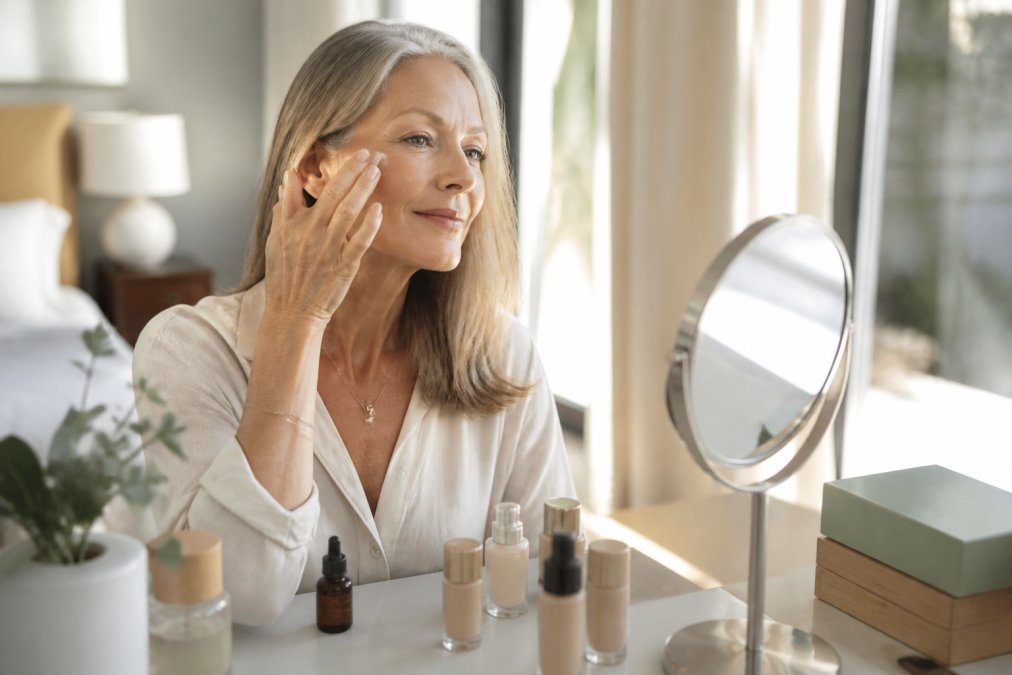
The best nontoxic foundation for menopause is one formulated specifically for reactive, mature skin. Our top pick is Clean Beauty by Joy, because it checks the boxes that matter most: organic botanicals, a barrier-supporting base, and a formula designed for skin going through hormonal change.
Sustainability and Packaging Transparency in Clean Beauty
Sustainability in clean beauty comes down to what's in the bottle and what happens to the bottle after. Packaging transparency means a brand tells you what its containers are made of and whether they can be recycled or refilled.
Frequently Asked Questions
What is the best foundation for menopausal skin?
The best foundation for menopausal skin is a nontoxic, hydrating formula that supports the skin barrier and doesn't settle into fine lines. Look for ingredients like botanical extracts, antioxidants, and mineral sunscreen. Avoid synthetic fragrance and parabens. Clean Beauty by Joy offers a serum foundation, providing buildable and lightweight coverage that feels breathable and comfortable all day.
What ingredients should I avoid in makeup for aging skin?
Avoid parabens, phthalates, synthetic fragrance, and formaldehyde-releasing preservatives. These can irritate sensitive menopausal skin and may interfere with hormonal balance. Also skip drying alcohols and heavy silicones that can emphasize fine lines. Instead, choose products with organic botanical extracts, antioxidants, and non-comedogenic oils that hydrate and protect.
How can I prevent foundation from settling into fine lines during menopause?
Start with a hydrating primer or moisturizer to plump the skin. Apply foundation with a damp sponge or brush, pressing it into the skin rather than sweeping. Use a lightweight, serum-based formula like those from Clean Beauty by Joy that contains skin-loving ingredients. Set only the T-zone with a fine translucent powder, and avoid baking. This keeps your complexion dewy and prevents creasing.
Does menopause make skin more sensitive to makeup ingredients?
Yes, declining estrogen levels thin the skin and reduce its barrier function, making it more reactive to irritants like synthetic fragrance and harsh preservatives. Many women experience redness, itching, or breakouts from products they previously tolerated. Switching to a nontoxic foundation with hypoallergenic, paraben-free, and phthalate-free ingredients can help calm sensitivity while providing coverage. Patch-test new products and introduce one at a time.
Menopausal skin doesn't need to settle for foundation that flakes, settles, or irritates. It needs a formula built for the barrier changes happening underneath. Clean Beauty by Joy makes nontoxic makeup with organic botanicals that support the skin microbiome, fight inflamm-aging, and protect against environmental stressors, all while delivering the coverage you actually want. Get started with Clean Beauty by Joy and give your skin makeup that restores instead of masks.

