

Table of Contents
- Why Heavy Coverage Foundation Is Different From Full Coverage
- Quick Comparison: What We Reviewed for Heavy Coverage
- Flawless Finish Liquid Foundation: The Best Foundation for Heavy Coverage We Tested
- How to Apply Full Coverage Foundation Without a Cakey Finish
- Full Coverage Foundation for Sensitive Skin: What to Check Before You Buy
- Shade Matching, Undertones, and Oxidization
- Pricing, Refills, and What You Actually Spend
- Conclusion
- Frequently Asked Questions
Last Updated: October 2, 2026
Why Heavy Coverage Foundation Is Different From Full Coverage
Heavy coverage foundation is a high-pigment formula built to conceal acne, melasma, redness, and dark spots in one layer; full coverage sits a step below it, evening skin tone rather than erasing what's underneath. The more pigment a formula carries, the more it settles into fine lines, clings to dry patches, and turns cakey by midday.
Quick Comparison: What We Reviewed for Heavy Coverage
The table below summarizes the products we tested, their costs, and who each suits best.
| Product | Price | Coverage Level | Best For | Finish |
|---|---|---|---|---|
| Flawless Finish Liquid Foundation | $46.00 | Sheer to full (buildable) | All skin types, sensitive and hormonal skin | Natural, dewy |
| The Refill - Foundation | $37.00 | Same formula, refill | Repeat buyers reducing waste | Natural, dewy |
| Pro Prep Face Primer | $37.00 | Primer base | Pore-blurring, blue light protection | Velvety, soft-focus |
| Blend it Foundation Brush | $31.00 | Application tool | Streak-free buffing | N/A |
| Samples of Primer & Foundation | $15.00 | Shade trial | First-time buyers | N/A |
Flawless Finish Liquid Foundation: The Best Foundation for Heavy Coverage We Tested
The Flawless Finish Liquid Foundation builds from sheer to full coverage without the tight, chalky feel heavy formulas usually leave behind.

Coverage, Finish, and Wear Time
One pump gives sheer coverage, two reach medium, and three deliver the full coverage you'd want for blemishes, pigmentation, or post-acne marks. The dewy finish keeps dry and mature skin from looking flaky.
Pros, Cons, and Who It Suits
What works: Buildable coverage from one bottle, non-comedogenic, safe for pregnancy, nursing, and menopausal skin. Ten shades across cool, warm, and neutral undertones.
How to Apply Full Coverage Foundation Without a Cakey Finish
Learning how to apply full coverage foundation comes down to three variables: prep, tool, and restraint. Most cakey results trace back to too much product applied too fast with the wrong tool, thin layers beat one thick one every time.
Prep: The Step That Decides Whether Coverage Sits Flat or Sinks In
Heavy coverage has no forgiveness for dry patches or unprimed texture. Work in this order:
- Cleanse, then apply a hydrating serum and let it absorb for two minutes. Glycerin-based serums plump the skin so pigment glides instead of catching.
- Moisturize and wait another two minutes, foundation applied onto tacky moisturizer will pill and separate within the hour.
- Apply one to two pumps of Pro Prep Face Primer with clean fingertips, pressing rather than rubbing. Its vitamin E, green tea leaf extract, and rosemary leaf extract protect against blue light and free radicals, and its soft-focus finish blurs pores.
- Give the primer 60 seconds to set; primer that is still wet will thin out your first layer and cost you coverage.
Tool Comparison: How the Same Bottle Gives You Three Different Coverage Levels
The tool you use changes the coverage of the same product by roughly a full level, and the finish too.

- Damp sponge (beauty sponge or blending sponge): Sheers out coverage the most, absorbing product and pressing what remains into the skin, best for a natural, skin-like finish on mature or dry skin. Expect to lose about a third of the coverage a brush gives. Stipple and bounce, never drag.
- Dense synthetic brush (like the Blend it Foundation Brush): Delivers the highest coverage per pump because bristles hold product on the surface rather than absorbing it. Buff in small circles from the center of the face outward to erase melasma or post-acne marks in one pass.
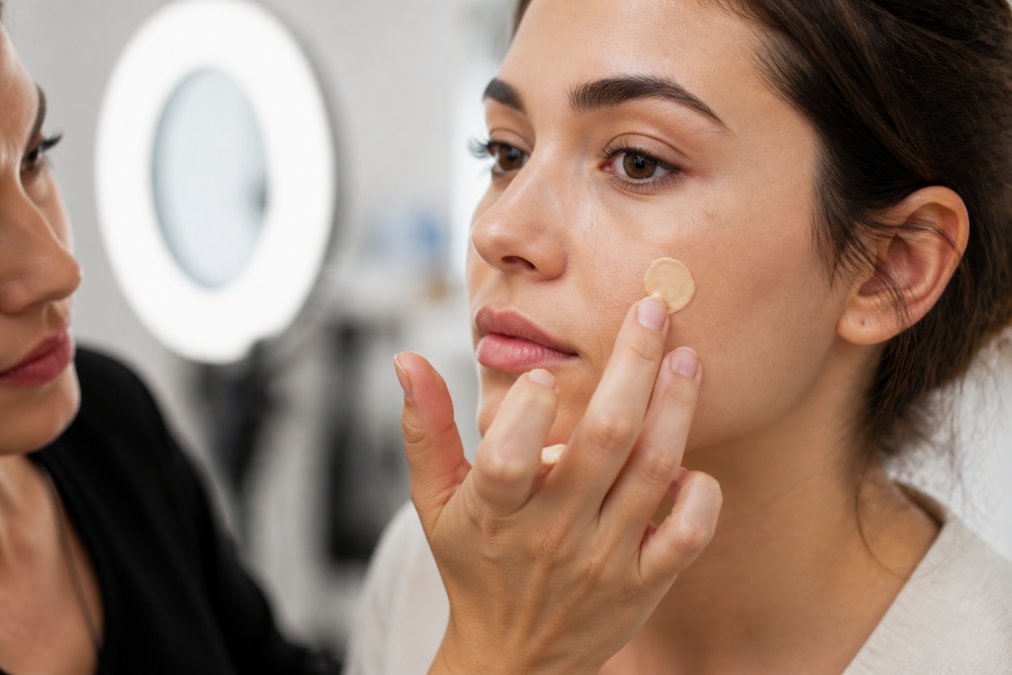
- Fingers: Body heat thins the formula and warms it into the skin, giving medium coverage with the most natural edge blend. Best for the perimeter and spot-concealing, worst for large areas because the finish turns uneven.
- Silicone applicator: Wastes nothing and gives a flat, full-coverage layer, but can look patchy on dry skin because it does not press product in.
Layering Order and Restraint
- Dot foundation on the center of the face, then blend outward.
- Buff with the Blend it Foundation Brush in small circles.
- Add a second thin layer only where needed, and only after the first layer sets for 30 seconds.
- Set the T-zone lightly with powder; set the rest of the face only if oily or if you need the makeup to last past eight hours.
Flashback and Photography: The Test Nobody Runs Until It Is Too Late
Heavy coverage is the most likely category to cause flashback, the white or gray cast in flash photos. The cause is titanium dioxide and zinc oxide, the same mineral pigments that make a formula gentle and give it sun protection. Invisible in a mirror, they reflect flash straight back at the camera.
- Apply your full routine in daylight, exactly as you would for the event.
- Take a selfie in a dim room with your phone flash on, then a second with no flash.
- If your face looks lighter, grayer, or chalkier than your neck in the flash photo, the formula is flashing back on you.
Full Coverage Foundation for Sensitive Skin: What to Check Before You Buy
Full coverage foundation for sensitive skin has to clear a higher bar than a tinted moisturizer, because reactive skin reacts to both pigment load and preservatives. The more pigment a formula carries, the more emulsifiers, film-formers, and preservatives it needs to stay stable, and every one is a potential trigger. Two checks matter most: the ingredient list and the shade-testing process.
Irritants vs. Comedogenic Ingredients: They Are Not the Same Problem
Most guides lump these together. They cause different reactions and require different label checks.
-
Denatured alcohol and alcohol denat. high on the list, which strip the skin barrier and make reactive skin sting on application.
-
Fragrance and essential oils, including limonene, linalool, and citrus oils, common contact allergens.
-
Chemical sunscreen filters in foundations that double as SPF, which can sting eyes and reactive cheeks.
-
Coconut oil, cocoa butter, and wheat germ oil, which rate high on comedogenicity scales.
-
Heavy silicone blends like dimethicone crosspolymer stacked with other silicones, which can trap oil and debris in pores on acne-prone skin.
-
Bismuth oxychloride, a mineral that gives a pearlescent finish but is a known irritant and pore-clogger for some users.
How to Read a Label for Acne-Prone Skin
Ingredient lists run in descending order of concentration. The first five ingredients are present in meaningful amounts; anything after the preservatives (usually phenoxyethanol or sodium benzoate) is under 1 percent and unlikely to be your trigger.
- Fragrance and drying alcohols, which irritate reactive skin
- Non-comedogenic claims that hold up, meaning the formula will not clog pores
- Botanical buffers like aloe, squalane, and shea butter that support the skin barrier
- Zinc oxide and titanium dioxide as mineral pigments rather than harsh dyes
- Niacinamide and panthenol, which calm redness and support the barrier while pigment sits on top
The Patch Test That Actually Predicts a Reaction
A single swatch on your hand tells you nothing about how your face responds, because forearm skin is thicker and less reactive than cheeks and jaw. Run a real test instead:
- Apply the foundation to a two-inch patch on your jawline, not your hand.
- Wear it for a full day, including through normal sweat and oil production.
- Repeat for three consecutive days.
- Watch for redness, itching, small bumps, or clogged pores at the patch site.
Why Heavy Coverage Is Harder on Sensitive Skin Than Sheer Coverage
A sheer formula uses maybe 10 percent pigment. A heavy coverage formula can use three to four times that, meaning three to four times the emulsifiers, thickeners, and preservatives to keep it stable. That's the real reason sensitive skin struggles with heavy coverage: it's not the pigment itself, it's everything holding the pigment together.
Shade Matching, Undertones, and Oxidization
Shade matching is where most heavy coverage purchases go wrong. A formula that looks perfect in the bottle can turn orange within an hour, oxidization, and the denser the pigment, the more obvious the shift.
Pricing, Refills, and What You Actually Spend
Pricing on heavy coverage foundation splits into two numbers: what you pay the first time and what you pay after that. The Flawless Finish Liquid Foundation runs $46.00 for a full-size 1 fl oz bottle. Once you own the glass bottle and pump, The Refill - Foundation costs $37.00 for the same 1 fl oz, where the long-term savings sit.

Conclusion
Finding a heavy coverage foundation that performs without punishing your skin is genuinely hard, especially when your skin is already reactive from pregnancy, nursing, or hormonal shifts. Clean Beauty by Joy built the Flawless Finish Liquid Foundation for exactly that situation, with buildable coverage from sheer to full, a non-comedogenic formula, and botanical ingredients like aloe vera, glycerin, and zinc oxide that nourish while they cover.
Frequently Asked Questions
What does high coverage foundation mean?
High coverage foundation hides redness, blemishes, pigmentation, and uneven skin texture with one or two layers. It differs from sheer or medium formulas because it uses a higher pigment load, so a small amount goes further. The Flawless Finish Liquid Foundation reaches full coverage at three pumps, while one pump gives a sheer finish and two pumps give medium coverage. Build in thin layers rather than applying one thick coat to avoid a cakey appearance.
How can I achieve heavy coverage without a cakey finish?
Start with a primer that smooths texture and grips the foundation, like the Pro Prep Face Primer. Apply foundation in thin layers, building from one pump to three until you reach the coverage you want. Use a dampened sponge or a foundation brush for a seamless blend, and set only the areas that need it with a light setting powder. Hydrating formulas with ingredients like glycerin and aloe vera help the foundation sit on the skin instead of on top of it.
Are there nontoxic foundations that provide full coverage?
Yes. The Flawless Finish Liquid Foundation is made with organic, vegan, gluten-free, and non-GMO ingredients, including aloe vera, glycerin, and zinc oxide. It is 80% organic and made in the USA. For anyone pregnant, nursing, or going through hormonal skin changes, checking the full ingredient list before buying matters more than the marketing label. This formula avoids clogging pores while still delivering buildable, heavy coverage.
How do I choose the right shade for heavy coverage foundation?
Match your undertone first, then your depth. Cool undertones suit shades like Cool 2.5 or Cool 7, neutral undertones match Neutral 1.5 through Neutral 4, and warm undertones work with Warm 5, Warm 6, or Sandy Warm 3.5. Heavy coverage formulas show shade mismatches more than sheer ones, so test before committing. The Samples of Primer & Foundation set gives you two shades and a primer, with about four days of product per container.
What is the best foundation for large pores and textured skin?
A pore-blurring primer plus a buildable foundation handles texture best. The Pro Prep Face Primer minimizes the appearance of fine lines and pores and creates a velvety canvas, while the Flawless Finish Liquid Foundation evens out skin texture without clogging pores. Apply the primer with clean fingertips, then press foundation in with a dampened sponge or the Blend it Foundation Brush for a seamless blend that does not settle into pores.

